The Alberta Museums Association's Community Engagement Initiative (CEI) works towards incorporating community engagement into the programs & services of the AMA and the general practices of the Alberta museum community. CEI supports museums by demonstrating the importance of community collaborations as a viable path toward sustainability. This blog provides tools & resources to support museums in creating & maintaining meaningful connections with communities.
Showing posts with label Alberta Museums. Show all posts
Showing posts with label Alberta Museums. Show all posts
Site visits
are an important part of the Alberta Museums Association (AMA)’s work. Whether
to offer a course, provide in-person advisory services, attend an exhibit
opening, or simply connect, site visits bring a human touch to the AMA’s
programs and services. Unfortunately, the pandemic-related public health
restrictions of the last two years meant we had to scale back our in-person visits
to Alberta’s museums. The lifting of restrictions, and many museums reopening
just in time for spring, presented an opportunity to get back on the road and
start reconnecting. Over the course of two weeks in March, Jennifer Forsyth, Lauren Wheeler,
and Itravelled around Alberta
visiting the six museums taking part in the Reconsidering Museums
project as pilot sites. Here are some of the highlights of the trips and a look
at the diversity of museums across Alberta.
I have been asked a lot in my life, “Why museums?” Why choose to go to school to study history with plans to work in a museum? Why decide to focus on collections and exhibits in museums as a career path? Why stay in museums given the current economy and uncertainty? The question is always, “Why museums?” But let me ask you a few questions and see if the answer becomes clearer.
The Critical Contributions of Regular Peer Connection among Museum Professionals
by Tara Beck and Isabella Borrelli
The journey towards this blog entry began in February 2020
when two colleagues sat down to consider how their experience with communities
of practice might contribute to the AMA Conference about museums and
organizational sustainability. At the time, conversations primarily revolved
around the value of communities of practice in combatting the institutional and
professional silos common across Edmonton’s museum landscape (Edmonton Heritage
Council’s Comprehensive Museum Strategy Report, 2012). Knowing the difficulty
in a major city, one can only assume that our counterparts in rural Alberta
face similar challenges.
A lot has happened since February which has encouraged us
to broaden our considerations of the ways communities of practice can serve us
in our work. Museums are at a pivotal point in their history. The Covid-19
pandemic has forced many of them to shrink dramatically, and in some cases
close. The unmasking of deep rooted institutional systemic racism has called on
museums to meaningfully address their histories and make changes for their
futures.
In hiring a Collections Officer at Fort Calgary, a goal of this new position was to provide a full-time opportunity for an emerging professional in the field. Recognizing that this person may need some help navigating all parts of the job, an experienced Collections Management professional, Gail Niinimaa, was engaged as a consultant to liaise with Fort Calgary’s President & CEO, Naomi Grattan, and work directly with the Collections Officer, Adrienne Dewsberry, as a mentor. In this post, they reflect on their experience with this project.
Miss Part 1? Click here for Reflections on the AMA Mentorship Program.
Working with Fort Calgary to Mentor a Junior Employee
Gail Niinimaa,
Niinimaa Enterprises Inc.
During the Alberta
Museums Association (AMA) 2019 Conference, at the reception at the Royal
Alberta Museum, I ran into Naomi Grattan, the new President & CEO of Fort
Calgary. We chatted about what we were up to and she mentioned that she may
like to pick my brain about their collection and some of their collections
management issues. I suggested that I would be happy to be a consultant to a
junior staff member and to work together with them, to share my knowledge and
to help them along the way.
In July 2019, the
Alberta Museums Association
(AMA) launched the Mentorship Program, a flexible, self-directed
program for Mentors and Mentees to share experiences, develop skills, and gain
insights on the challenges, opportunities, and innovative practices in the
museum community. Running from October 2019 to August 2020, the inaugural year
of the Program was impacted by the COVID-19 pandemic. In this post, participants from the first cohort reflect on their experiences adapting the
Program to meet their goals.
Being a Mentor in
the Second Half of Life
Gail Niinimaa,
Niinimaa Enterprises Inc.
2020 is a year
for me where I have definitely moved into the second half of my life. This is a
time when I can give back and decide what impact I may want to leave on this
world! In 1979, when I started at Glenbow and was given my pension documents to
sign, the date of April 14, 2020, seemed very far into the future. I remember
remarking to my colleague who was about 20 years older than me that there was
no way that I would still be at the Glenbow in 2020! My prediction was fairly
accurate – I did formally leave the Glenbow in 2008 after a combination of full-time
and contract work over the years – but I have continued to be an occasional
consultant for them in the last 12 years, the most recently being in March 2020
right before COVID-19 shut down the world.
Congratulations to Herman Yellow Old Woman, recipient of the 2020 Lieutenant Governor’s Award! This Award recognizes Herman’s instrumental role in championing the rights of Indigenous communities to represent themselves and to have a voice in creating and shaping museum spaces.
Herman Yellow Old Woman is presented with the 2020 Lieutenant Governor's Award.
In selecting Herman for this Award, the AMA Board of Directors recognizes his spirit of giving and important role in establishing best practices for the Alberta museum community. Herman’s achievements at a provincial, national, and international level have made an exceptional impact and contribution to Alberta’s museum community.
Among these achievements, Herman was a key member of the committee behind Glenbow’s Nitsitapiisinni Gallery, created to reflect the Blackfoot worldview. The Gallery has been internationally recognized as one of the first exhibits told from an Indigenous perspective and is the epitome of the reconciliation and healing museums are now striving for.
One of Herman’s most impactful contributions to the museum sector has been his fight for the repatriation of Chief Crowfoot’s regalia from The Royal Albert Memorial Museum in Exeter, UK, an effort that began over a decade ago. Alongside his colleagues at Blackfoot Crossing Historical Park, Herman worked tirelessly to educate both the public and Exeter City Council about the importance of Blackfoot Cultural Patrimony, and encouraged them to see clothing not as objects or artifacts but as living beings – ancestors who, upon their return to their people, have the ability to help heal the harms done by the colonial legacy of museums. This year, the hard work paid off when Exeter agreed that Crowfoot should be returned to the Siksika Nation. Said Mr. Yellow Old Woman: “I feel like we're bringing his spirit home.”
Herman was instrumental in the development of the First Nations Sacred Ceremonial Objects Repatriation Act (FNSCORA), and the repatriation of over 260 sacred and ceremonial objects from Glenbow’s collections and many more from other museum collections. He has cared for museum collections worldwide by conducting ceremony, visiting and caring for sacred bundles and the ancestors residing in museums in Canada and internationally.
Herman has left an indelible mark on Alberta’s museum sector. His contributions are a gift to future generations, not only for the Blackfoot, but for museum professionals navigating the changing role of museums in society and the necessary work of reconciliation.
Congratulations
to Lougheed House, the 2020 recipient of the Robert R. Janes Award for Social
Responsibility! This Award recognizes Lougheed House’s commitment to creating
exciting and unique visitor experiences that tell the lesser-known stories of
Calgary and to integrating social responsibility into all aspects of its museum
practice.
The team at Lougheed House has gone beyond the traditional historic house museum to embrace, challenge, and educate the communities around it and evolve alongside them.
“At
Lougheed House we believe that our story is best told together.”
Watch Lougheed House's acceptance video below:
Through its many ongoing partnerships with Indigenous, racialized, queer, and feminist groups, Lougheed House is telling the lesser-known histories of the many and varied communities it serves. Its responsiveness to the feedback gathered from these diverse communities firmly positions it as a leader in the museum field.
Métis veteran Sergeant Major George Pambrun, Retired, at the raising of the Métis flag at the Lougheed House Garden Festival in July 2019.
Lougheed House created a Community Engagement Framework and a Re-Imagined Exhibition Development Plan that is embedded with community feedback. Standing out as a model for other institutions, this framework guides Lougheed House’s work with the community and enables it to transform its exhibit spaces to reflect the more diverse history of Calgary.
Exhibits and events, such as Exploring Métis Identity: Past and Present and Roar: Exploring Queer History and Gender Identity, are shining examples of Lougheed House’s re-imagining and historic illumination.
Costumed attendees pose for the photo booth during Outliers: Queer History in Calgary in May 2019.
In focussing on the evolution of the House and telling these stories together, Lougheed House is building a thriving and sustainable organization that exemplifies the active role museums can take alongside their partners in shaping the narrative of a dynamic Alberta.
Congratulations
to Harpreet Dhanjal, the recipient of the AMA’s 2020 Leadership Award for
Engagement! This Award recognizes Harpreet's commitment to equity, diversity, and inclusion in her role
as Public Programmer at Calgary’s TELUS Spark.
Harpreet is passionate about making the cultural
sector more welcoming and inclusive. “It’s because I never saw myself here,”
she says, “that community engagement and equity work is such an important part
of my practice.”
Watch Harpreet's acceptance video below:
Never one to
ignore or let slip an opportunity to advocate for those who are
underrepresented, Harpreet is exceptional in her ability to engage diverse
community members with culture. She carefully designs visitor experiences that
are relevant, narrative driven, modern, and occasionally provocative, such as
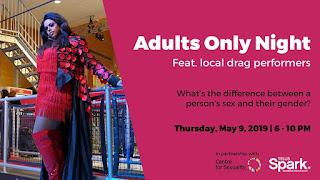
the Adults Only Night program titled He, Her, They, Everyone, and You (A.K.A.
Beyond the Binary), a program that celebrated gender diversity while educating
visitors on the intersection of sexuality, gender, identity, science, history,
and art.
When developing
programming, Harpreet involves experts who represent a range of identities and
perspectives. Fearless in engaging new community partners, Harpreet has created
programs that bring together research academics, drag performers, and rocket
scientists. She has positioned TELUS Spark as a trusted ally and sought the
expertise and collaboration of LGBTQ2S+ community partners.
Passionate about
making the cultural sector more welcoming and inclusive, Harpreet always
prioritizes equity, diversity, and community engagement in her work. Harpreet
crafts meaningful visitor experiences that provoke curiosity, reflection,
discussion, and interaction, creating brave spaces for anyone and everyone to learn,
play, and engage.
A dedicated advocate and ally for underrepresented communities, and a champion for diversity and inclusion across the museum sector, Harpreet
exemplifies the leading role museums have as agents of social
responsibility.
Congratulations, Harpreet!
Leadership Award for Education
TELUS World of Science - Edmonton
Congratulations to TELUS World of Science – Edmonton (TWOSE), the recipient of the AMA’s 2020 Leadership Award for Education! This Award recognizes TWOSE’s work in creating safe and supportive spaces for science learning for girls and women.
An all-female team worked across departments to tailor programming at TWOSE to individuals that identify as women in order to address gender gaps and improve accessibility in Science, Technology, Engineering, and Mathematics (STEM) learning. The team set out to create a climate of support and change for women at all stages of their science careers.
Watch TELUS World of Science's acceptance video below:
The five distinct programs making up Women and Girls in STEM focus on addressing the issues that prevent women and girls from pursuing careers in science. Presenting material in an environment that is supportive of girls and women, the programs aim to increase confidence to pursue STEM careers, decrease gender stereotyping by providing a positive space for girls to interact with professional female role models in STEM fields, and improve positive peer influence by creating safe spaces to explore STEM topics and to learn new skills in the TELUS World of Science – Edmonton makerspace.
Designed to support girls aged ten to adults, the Women and Girls in STEM programs promote ongoing learning at critical ages where women and girls tend to lose interest in STEM. Not only do the programs provide an opportunity for girls to interact with like-minded peers, they also foster a support network of confident female STEM researchers.
These educational programs are engaging future and current female researchers’ hearts and minds in science. In empowering women and girls, TWOSE is a role model to their peers and colleagues of the importance of museums as agents of social change.
Congratulations, TELUS World of Science – Edmonton!
by Vanessa Puczko Social Media Community Manager, Summer Intern Canada’s Sports Hall of Fame
If there was ever a need for the
country to come together, the time is now.
A time for inspiration.
A time for hope.
During this unprecedented time, Canada’s
Sports Hall of Fame is aiming, as always, to unite Canada through sport. We
know that sport has the power to bring people together, and Canada has no
shortage of incredible sporting moments! But as we faced cancellations, we
needed a different way to connect with Canadians.
On the heels of the recent Alberta Museums Association (AMA) conference, As a Whole: Well-being, Health, and Museums, it’s refreshing
to learn that November is recognized in many communities as Arts and Health
Month. The goals for this event, as noted by Arts Health Network Canada, are “to promote the integration of
the arts—including literary, performing, and visual arts and design—into a wide
variety of healthcare and community settings for therapeutic, educational, and
expressive purposes.”
Leading the way in Alberta is Edmonton, with Mayor Don Iveson issuing a City
Proclamation on November 1. This was presented at the McMullen Gallery, located
at University of Alberta Hospital, by Councillor Jon Dziadyk.
Professor
Helen Chatterjee will be delivering the closing keynote address, “Museums,
Health, and Well-being: The Bio-psychosocial Impact of Museum Participation,”
at the Alberta Museums Association 2019 Conference. In advance of the
conference, Prof. Chatterjee spoke with Ann Ramsden, Executive Director of
the Arts and Heritage Foundation ofSt.
Albert, for an interview.
You are a
professor of Biology specializing in genetics, evolution, and environment. With
this academic background, how did you become interested in museological
research?
I trained as a zoologist with a PhD in primatology,
and my zoology research has always involved using zoology museum collections to
look at morphological adaptation, evolution, and conservation of endangered
species. During my PhD, I ‘inherited’ University College London’s Grant Museum
of Zoology. Initially, I began as a TA, teaching using the collections, but
when the Curator retired, I took on that role. I ran the Museum for ten years
before becoming Director, then Deputy Director of UCL Museums for five further
years. I still use the museum today for teachingand research.
During my time at the Grant Museum, I began
researching object-based learning and the value of museums to health and well-being.
Ten years ago, I was awarded the first ever UK research grant to explore the
role of touch and object handling in relation to well-being and health, and my
work has expanded from there.
Dr. Carol D. Ryff will be delivering the opening keynote address, “Bridging the Museum Experience to Well-being and Health,” at the Alberta Museums Association 2019 Conference. In advance of the conference, Dr. Ryff sat down with Dick Averns, artist and engagement coordinator with CARFAC Alberta, for an interview. Averns: Thanks for sharing some insight into your work, Carol, on the Conference theme, As a Whole: Well-being, Health, and Museums. So, how does your work and research promote health and well-being, and how do you see museums as relevant?
Ryff: For the last thirty years, my research has addressed three main questions: What is human well-being? How can we measure it? And how does it matter for health? My past research has not explicitly linked museum experiences to health and well-being, although I am an advocate for work in that direction. I’m especially interested in how partaking of museums might impact people’s sense that their lives have meaning, purpose, and direction, as well as their sense that they are experiencing personal growth over time.
Joe
Vipond
has worked as an emergency physician in Calgary for eighteen years. In 2012, he
became one of the key organizers for the successful Alberta Coal Phase Out
campaign and the subsequent Canadian Coal Phase Out campaign. He currently is
involved with The Canadian Association of Physicians for the Environment (CAPE),
the Alberta Wilderness Association, and the CAPE-Alberta Committee, a regional
group of physicians, nurses, and other health professionals who successfully
negotiated the creation of Alberta Health Services first Office of
Sustainability. When not doctoring or trying to change the world, he does his
best to be a good husband and dad to his two amazing children, Sadie and Willa.
Please provide a
brief overview of your role and the work that your organization does. How do
you see your work connecting to the museum world?
Museums have
two important connections to climate. First, they are institutions of
communication. Through museums we learn. And we desperately need to learn more
about the science of climate. It has become the undiscussable topic...who
really wants to talk about the possible end of the world, and our role in it?
But we desperately need to talk about it. Because by ignoring the subject, we
also make it impossible to fix it.
Cathy Molloy is the Director of Markham
Museum. She was born in Toronto and grew up in the Rouge Valley, specifically
on the edge of one of its wonderful ravines. Before returning to Markham Museum
and becoming its Director in 2008, Cathy worked as a Curator at both the Oshawa
Museum and Markham Museum, and was instrumental in raising funds to build the
Aurora Cultural Centre. Cathy’s interest in environmental issues goes back to
her teen years where she participated in the Boyd Conservation Archaeological
Summer Field School, which was the start of a life-long desire to better
understand how humans interact with the natural world.
Please provide a
brief overview of your role at Markham Museum and the work that your
organization does.
The Vision of Markham
Museum is to "inspire a life-long curiosity, pride in, and care for, the
people, tangible heritage, places, lands and waterways of the City of Markham:
past, present and future.” Our mission is to “examine Markham by engaging
technologies developed and used by all human cultures to live in the natural
world; agriculture and food; material culture; engineering and environmental.
We will engage science, industry, history and the arts to understand how
Markham became what it is today and what its possible futures could be”.
One
of the questions that repeatedly comes up when museums are asked to think about
how they can engage with environmental issues is “our museum is about [insert subject here] - how do we engage
in discussions around the environment when it does not apply to us?” When
museum professionals look at their institutions through a different lens,
however, it becomes obvious that there are many connections to the environment.
By highlighting these connections, museums can be agents of social change by
engaging their communities in timely discussions around this vitally important
topic.
Still
not sure how your museum might fit? Consider the following broad examples:
A
wonderful perk of working for the Alberta Museums Association is the
opportunity to travel across the province and experience various communities and
their regional museums. The site visits we conduct with member institutions
allow us to meet people involved in all aspects of museums as staff,
volunteers, or board members. Last year, Lauren Wheeler and I were fortunate enough
to also meet the community members whose stories and passions are exhibited
within the museum walls. At the Musée de St. Isidore, located very close to
Peace River, the truly unique history of the township is shown throughout the
museum and can be experienced in the attached community complex. At the time of
our visit, the museum had not yet opened its doors to the public, but other
tenants in the Centre culturel de St. Isidore could already see their lives and
work directly reflected in the museum.
The Witness Blanket, by Kwagiulth / Salish Artist Carey Newman, is comprised of hundreds of artifacts, each with its
own story, from and relating to Canada’s residential schools. The pieces are
mounted on cedar panels and are ‘woven’ together to create a blanket of shared
memories.
How did a small, rural museum like the Peace River
Museum, Archives, and Mackenzie Centre (PRMA) become a host venue for the nationally-acclaimed
exhibit The Witness Blanket? It was all
due to the collective resourcing of three partners: Sagitawa Friendship
Society, Peace River Correctional Centre, and the PRMA. By building on existing
relationships and acknowledging the diversity each partner brought to achieving
this goal, we were able to accomplish something that just one could not. We
began in January 2015, and over the next 18 months prepared to receive ‘the
Ancestors’, the Witness Blanket, on June 28, 2016.
Dave Matilpi, Aboriginal Elder, artist and teacher, mentored
us at our meetings and through cultural teachings and a workshop he calls My Broken Journey. We learned of his
life experiences, including as a residential school student. Most importantly,
he shared the optimism he holds today for the healing and reconciliation that
began across Canada.
As the Royal Ontario Museum (ROM)’s Digital Engagement Coordinator, Ryan is focussed on digital content creation and campaign and community management as well as building digital capacity within the institution. Ryan is active in the global museum community and has volunteered with the Canadian Museums Association's Young Canada Works Project, the New Media Consortium's Horizon Report: Museum Edition and the board of ICOM Canada. Ryan is currently a board member of the Virtual Museum of Canada and the Museum Computer Network's part-time Digital Content and Community Manager. In anticipation of his upcoming keynote and session at AMA Conference 2016, Lisa Making, Director of Exhibits and Communications at the Royal Tyrrell Museum, met with Ryan to discuss digital engagement in museums.
Lisa Making: ROM has taken a unique approach to managing social media by allowing multiple profiles for one organization. Can you share with us some of the strengths of this approach, as well as some of the challenges?
Ryan Dodge:The decision to open up multiple official twitter accounts was not one taken lightly and was in line with an overall strategic direction taken by the museum to organize our collections around Eight Centres of Discovery back in 2013. Before I came into the role in 2012, our @ROMPalaeo and @ROMBiodiversity teams had already started accounts with lively dialogue and engagement. The decision became whether to ask them to close those accounts or to start new ones for the remaining six Centres of Discovery once they were fully launched in 2014. In the end we chose to expand to give our public the opportunity to engage with the areas of the museum that they are most interested in. Our aim here was to allow people to self-select and engage with the content they want – more on that here: https://www.rom.on.ca/en/blog/the-roms-presence-on-social-media.
We need to talk about Pokémon Go. In
case you haven’t looked at the news lately, Pokémon Go has taken over
everything. Here at the Alberta Museums Association office, we are not immune
from the excitement, and as a staff we have discussed it in many ways. Some of
us fell hard for the nostalgia of a favourite childhood game adapted for today.
Others madly googled “what is Pokémon Go?”. We discussed the obvious safety
concerns, as news stories erupted about the chaos ensuing from people wandering
around staring at their phones and not looking where they are going. And of
course, we watched with interest as museums around the world started buzzing
about Pokémon in and around their buildings.
Technically,
I am a Millennial, but I was a little too old to be drawn into Pokémon when it arrived
in North America in the 1990s. My limited knowledge was picked up second hand
from my younger brother’s obsession – when he got a dog for his tenth birthday, he named her Eevee (after a Pokémon). However, the rapid spread of the
app, even in Canada where it is not officially available yet [edit: as of today, it is available
Canada-wide!], is fascinating. The augmented reality aspect of the app has
brought a game out of the basement and into public spaces. As a public
historian, I am especially interested in the implications and possibilities for
museums when people start visiting museums and other heritage sites in search
of elusive Pokémon.
Two camps
have already emerged in the museum world in relation to Pokémon Go; those
encouraging people to visit by showing off which Pokémon can be found at their
museum, and those politely asking people to refrain from catching Pokémon at
their museum.
An
interesting article on the increasing importance of socially responsible work
in museums. How can we draw connections from this to our own work in Alberta?
How can we do more?